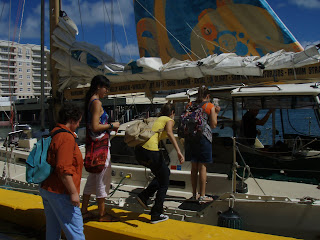
On November 3, 2009 at 11:00 a.m., a representative group of three students from my English courses visited the sailing vessel, Ocean Watch, docked at Pier #1, Old San Juan. The Ocean Watch is presently circumnavigating the Americas. It departed north from Seattle, Washington, across the Arctic due east, down south past New York with a brief 4-day stop in Puerto Rico before heading to Brazil. You can follow the expedition around the Americas, clicking their site under my favorite links.
Dr. Michael Reynolds, Oceanographer in this scientific sailing exploration and adventure invited us to visit and tour the sailboat and kindly made the time to talk to students. Those who were unable to go wrote questions to the crew, which I emailed to Dr. Reynolds. Today I received his answers to the students. Following is a copy of the email.
To: Eva de Lourdes Edwards, delourdes@mac.com
From: R. Michael Reynolds, RMR Co., LLC
cc: none
Date: 2009-11-13, 02:20:33
Subj: Questions from students
Hi,
It has taken me some time after leaving San Juan to get organized so this reply will be a little late. I am going to put these and some other questions into one of my regular reports.
Questions:
Q: In addition to watching the ocean, what other things do you do during the voyage that you may not put in the website? (Jenni)
Ans:
This is a small boat (I have to remember to call this a boat, not a ship) and our crew is only six people. Therefore there are chores we all must share. I cook dinner or clean the dishes sometimes. I help keep the boat clean. I stand watch like everyone else. Do you know what "watches" are? We are divided into two groups. Each watch group will be on duty to operate the boat while the others are free to sleep, eat, or just relax. Here are the hours of the day for watch: day: 06-10, 10-14, 14-18, and night: 18-21, 21-00, 00-03, 03-06. Each group takes turns. As I write you this now it is 2:50 in the morning and my watch is almost over, but I only have three hours to sleep then I have to be back up at 6 am.
Q: What do you think about the contamination problems in the ocean around the Americas? (Yineza and Kenny)
Ans:
I am very concerned about how humans have treated the oceans as a dumping place for garbage, pollution, and human waste. However, it is easy to see when you are out here in the open ocean how we might think the ocean is infinite. It seems so vast. But of course it isn't.
Q: In what moment did you decide to go around the Americas and why? (Janice, José Manuel and Kiara)
Ans:
I work with the University of Washington and one of my colleagues suggested I come to a meeting with some people who had this crazy plan to sail around North & South America in a sailboat. I went to the meeting and met the crew and I realized this was a chance of a lifetime for me. I have traveled a great deal as an oceanographer and I have sailed small boats for fun. But I have always wanted to do blue water sailing offshore. This was my opportunity to sail and do something good for the Earth.
Q: What do you recommend to protect our ocean? (Janice, José Manuel and Kiara)
Ans:
First educate yourself. Take courses, read magazines, and learn all you can. Don't just learn how there are problems; learn all about the wonders of the sea. Second, start doing the little things to change your habits. Never, never throw plastic in the sea and don't be afraid to tell others the same. Drive less; think about how you can conserve energy. All the little things. And third, become political. Join an environmental group, write letters to politicians, and stay informed on local issues. Remember the old advice to think globally and act locally.
Here are two questions that can have the same answer.
Q: What have you seen that you consider amazing? (Frances)
Q: What is the most impressive thing that you have seen in this voyage?
Ans:
We have seen so many amazing things so far: whales, polar bears, huge ice bergs, storm waves fifty feet high and glorious skies full of stars. But the thing I am enjoying the most is occurring right now in the equatorial ocean: the clouds. This is the place where weather happens. Huge towering cumulonimbus clouds rise to the top of the atmosphere then spread across the sky as anvils. These are a joy to watch. Oh yes, the stars at night are limitless.
Q: What inspired you to make this cruise? (Yolady, Irishka, Zuleyka)
Ans:
I have lived a good life. I have a terrific family and my job has taken me all over the world. As an oceanographer I have been concerned with the environment my whole career. But I have not had the opportunity to "give back." At least to my satisfaction. Around the Americas fills my wish. I can meet people and show first hand how important it is to protect our natural world. And it's fun too!
Q: What do you need to travel around the Americas? (Evalyannit and Indira)
Ans:
I am not sure how to answer this question. First you need people with vision; people who have the idea that with this trip we can capture people's imagination and interest. Next after the idea you need money. This is not a cheap trip and so you need supporters who will donate money, time, and gifts to support the project. You need a crew of dedicated sailors. People, and their families, who will take about two years out of their life for this project. And then, you need people like you who take an interest in what we are doing, and, very important, in what we have to say.
Q: What is interesting and entertaining about our oceans? (Cindy and Xiomara)
Ans:
The ocean is a wonderland and the more you look into it the more you can learn about ourselves. Did you know a dolphin can hear your heartbeat in the water? That the eyes of an octopus are much more advanced than our human eyes? That the Albatross travels twenty thousand miles to bring some food home to the family? Read all about it and you will be amazed. Read, read, read.
Q: How does it feel to discover different cultures? Do you like to learn from them? (Pamela)
Ans:
One of the most exciting parts of this expedition is that we are meeting and talking with people of all cultures along the way. We have met Native Americans on Vancouver Island, Inuit (Eskimo) people in Alaska and Canada, and now we are entering the Latin communities from Puerto Rico, South America, Central America and Mexico. We are all thrilled and excited to meet these people and to learn from them their lives. Everywhere we go we hear a consistent story of concern for the changing ocean and the changing climate.
Q: What made you decide to work for the environment? (Ninotchka)
Ans:
You never know where your life might take you. I was born in Dallas Texas and never had too much to do with the ocean until I began graduate school. Actually, I decided to become an oceanographer because I wanted to study Earth science (Geology, Geophysics, or Physical Oceanography) and at that time Oceanography was new. As I studied Oceanography I became aware of the environmental issues and so it was natural to try to share that knowledge with others.
Q: What does your family think about what you are doing? (Lizette)
Ans:
They miss me of course. I always walked our dog Lucy and now they have to do it rain or shine. So I think they will be happy to see me come back.
Q: What has caused you the most fear? (Marisely)
Ans:
The first time I was hoisted to the top of the mast in a canvas chair I was a little nervous. I go up there to tend to the climate instruments. Now I am used to it. Also I miss my family and I fear something bad might happen and I am days away at sea. But I worry far too much.
Q: How can this expedition help nature instead of just being aware of its problems? (Juan Carlos)
Ans:
Our main supporting organization is called "Sailors for the Sea." Their goal is to convince sailors to become protectors of the sea. These sailors will carry the idea from their own personal choices to friends, employees, and politicians. That is one way the message can go from idea to practice. But the truth is that being aware is the first step in actually doing something. We want to stimulate people to begin to learn the issues.

Thank you, Dr. Reynolds, and all the Ocean Watch crew.


 by Stan Zimmerman, where he states: “Mine works like this – pull on my sailing gloves, drop and secure the jib, reef the main, then grab the boots, and don my foul weather pants.” We laughed at the boots in the tropics but we pretty much followed a similar routine.

 . Time evanescent, a pre-Columbian Caribbean glimpse. And again, like little children, a sounding sigh, eyes filled with joy, like Christmas day in the morning.
 We planned for Culebra but the wind was against us. So, we sailed with the wind abeam, south, to Vieques. We anchored at Punta Arenas, western Vieques at about 17:00, facing Monte Pirata (988 ft). I had the Beatles’ collection in my iPod (226 songs), which played chronologically until just before the Abbey Road album, where we stopped the music to anchor. We sailed only a few nautical miles from the east coast of Puerto Rico, but we might as well have sailed through waves of joy, across the universe, as in the Beatles’ song by that name.

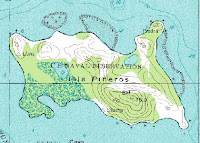
 On Friday morning, the Captain snorkeled the coast to check the reef area. Kevin and Julie checked the anchors. I stayed onboard and took care of the galley mess from the night before, plus jotted some notes for this blog. Even though the visibility was not great due to the weather, two manta rays and blue tropical fish schools were sighted.

 (1951), provides an eloquent description of tides and their connections with the moon, currents, flora and fauna in the sea, and yes, sailboat movements. In 1962, she published, Silent Spring, where way ahead of her time, she denounced the future impact of industrial waste. Industry and government, with the help of prominent male scientists accused her as a crackpot, a modern day witch-hunt. If we had only listened. Now Rachel Carson (1907-1964) is revered as a great writer, ecologist, and scientist (see picture below). She has more books, though I highly recommend the two I mention. They are very well written, which makes for enjoyable reading, and they are still informative.


 by David Owen Bell, printed by Cornell Maritime Press (1992), which is all about docking and undocking a sailboat—berthing, unberthing; arrival, departure; alpha, omega; the beginning and the end of a sailing adventure. Bell states that, “Many people consider good dockmanship to be the mark of a competent skipper.” For many a sail lately, while I have been the designated captain, I have managed to do this task with greater and lesser degrees of apprehension (I’ve a good record so far of not damaging body or property.). The more I do it, the more I realize, it is not about an individual’s competence to manage the task, but rather an individual’s ability to conduct the task, much as an orchestra conductor leads musicians, instruments, environmental acoustics and surrounding audience. Bell says there are three components to any docking situation: (1) elements under your control: the engine, rudder and dock lines; (2) external forces beyond your control: wind and current; and (3) the human factor, partially under your control: attitude, reflexes and perception—yours and those of the crew. Docking to me is orchestrating all these factors at once in a very quick, brief, flashing sacred moment in the craft of sailing. It is sacred, if seen as entering and leaving the cathedral of the sea. Conversations cease, silence rules over occasional warnings, and everyone is focused on the musical overture.
 (1998). He starts every chapter with a log entry for the sailboat Brendan Isle, as it sails into the icy waters of the Labrador Sea, Davis Strait and Baffin Bay. As it ventures north, he states, “… you are a sailor, moving along with the forces of nature rather than against them. You are a minion of the wind—only partially in control of where you go …”