Quote of the Month

"Not all those who wander are lost." J.R.R. Tolkien, The Lord of the Rings, 1954.

“We must change our attitudes toward the ocean. We must regard it as no longer a mystery, a menace, something so vast and invulnerable that we need not concern ourselves with it … Instead we want to explore the themes of the ocean’s existence—how it moves and breathes, how it experiences dramas and seasons, how it nourishes its hosts of living things, how it harmonizes the physical and biological rhythms of the whole earth, what hurts it and what feeds it—not least of all, what are its stories.” Jacques Yves Cousteau, 1910-1997.

"It's the glory of the sea that has turned my head." Robert Louis Stevenson, Treasure Island, 1894.

Saturday, November 6, 2010

Retro Sail – 1979


I once lived in Greece. Sailing the Greek islands, hence there is a Greek flag flying aft in the 1979 picture. I was 28 years old and my son Gene was 4. In the photograph, we are sitting together on the port side of the sailboat, the right side of the picture. I was so thin then, 108 pounds. I worked at the Hellenic International School, teaching French and English. In the Greek school system women could not wear pants, only skirts below the knee. Heather, also in the picture, was the music teacher and her husband was manager of Cape Sounion Marina, where the temple of Poseidon still stands. She had two children and we would all sail together whenever there was a sailboat available to deliver or test. That’s where the sailing spirit seduced me, and has faithfully stayed with me in good times and bad times.
Cape Sounion Marina

Oftentimes I have asked myself how a young girl from the green highlands of Naranjito ended up so enamored of the blue sea and sailing. Julia de Burgos, a well-known Puerto Rican poet says it best in her poem, Ronda sobremarina por la montaña. This title has been translated into English as, Supersea Stroll through the Mountain, in the bilingual book, Song of the Simple Truth (1996), where one can read her complete poems.

--Almamarina… Almamarina… 
Eso me dijo el viento cuando le di la mano en la montaña. 
… 
--Almamarina…
Eso me dijo el viento ruborizándose en mis ojos,
nerviosos, 
enamorándome. 

(--Seasoul… seasoul… /That’s what the wind said when I gave it my hand in the mountain. … 
--Seasoul… /That’s what the sea said blushing in my eyes, /nervous, /courting me.)

Temple of Poseidon
Poseidon, zealous god of the sea, kept Odysseus lost at sea for 10 years after the Trojan war. He eventually sailed home to his wife Penelope who waited for him in the island of Ithaca. The Temple of Poseidon still keeps a watchful eye over the god’s realm. The marina, at its feet, is still a humble reminder of human courage. Greek men (and one woman that I know of, Atalanta) dared to explore this realm on floating islands, challenging fears, risking life and fortune, defying Poseidon.

I sailed the Cyclades, a string of islands southeast of Cape Sounion. As we approached an island, the whitewashed homes with aqua blue doorframes painted the hillsides. The port areas were sprinkled with tavernas boasting outdoor tables and chairs, intertwined with boating shops, souvenir stores, ferry boats, buses, lots of people and noise. The children couldn’t wait to explore the shore, find the ice cream shop, and run around in town. Trying to save a little money on dock fees, we would anchor out and dinghy to shore. An adult stayed on the boat to keep watch. I often volunteered for this task, which made everyone happy. After so many hours at sea, everyone wanted to go ashore. These were my moments of freedom. Illusory in retrospection, naïve at best, I felt free. I’d stand open-armed like Da Vinci’s Vitruvian Man, facing the wind and singing, screaming, dancing, and laughing out loud. It was a sense of freedom, not so much from people, but more so from social norms, proper behavior, and lady-like roles. I was Atalanta with the Argonauts, looking for the Golden Fleece.

The Cyclades or Kycládes form the plural of Kyklás, from kíklos, meaning circle or ring. My Greek sailing experience was the beginning of a new ring in my life’s spiral. A mother bird’s push unto the open sky, and the young bird soared with open wings. I feel that same feeling every time we motor out of the marina, when we raise the sails, and turn off the engine. The instant the engine is off, and the wind presses on the sails, I soar.


Song of the Simple Truth: The Complete Poems of Julia de Burgos (Dual Language Edition:: Spanish, English) (Spanish and English Edition)--Almamarina…
Hubo luego, en silencio, como un desplazamiento
de una niña de agua en la sed de los valles,
La voz sobremarina se irguió sobre los cerros,
y partió para siempre con la niña en el talle.

(--Seasoul… /Later, in silence, there was something like a surge / of a water-girl in the thirst of the valleys, /The supersea voice rose over the mountains /and left forever with the girl on its waist.)

As I fast approach 60, the rings in my spirals are narrower, but they still soar, in Puerto Rico’s easternmost islands, circling, like the Cyclades off Cape Sounion, Fajardo’s lighthouse.
Atalanta-detail in Rubens painting

Wednesday, October 13, 2010

Bebe II

Log: Sunday, October 10, 2010 (0900-1530). Sailboat: Bebe II. Winds: S, SE 9-15 Knots. Seas: 2-5 feet. Weather: high 80’s, very hazy, cumulus clouds to the east.

It has rained so much in the past two months. Hurricanes have passed north of Puerto Rico but their elongated spiral arms have caused copious rains, flash floods and numerous thunderstorms in the island. Tropical depressions and waves followed suit, with only moments of sunshine in between.

Sunday morning was such a moment, with a break in the clouds. The sun peeked through the haze and my sailing mates, Ramón and Silvia, agreed to go sailing. I drove to Fajardo, to the Isleta Marina ferry dock. This islet off Fajardo is Bebe II’s new home.

I had not sailed Bebe II since August’s St. John adventure. I was the first to arrive at the dock. Seeing her there all alone was like seeing a dear old friend. As I went onboard, like old times, I opened her portholes and hatches and I started cleaning heads, sinks and counters. Do you know what the first rule of sailing is?

The science fiction movie, Serenity, came to mind. Captain Mal answers his question to the new pilot: “Love. You can learn all the math in the ‘verse, you take a boat in the air that you don’t love, she’ll shake you off just as sure as the turn of the worlds. Love keeps you in the air when she ought to fall down, tell you she’s hurt before she keels. Makes her a home.” It felt like coming home.

We sailed and sailed. We were not interested in docking, mooring or anchoring. It was all about feeling the wind in our face and in the billowing sails. Listening as the water rushed by her sides. Tasting the sun’s fire in our skins. Watching sun sparkles in the waves and in our reddening shoulders. Breathing in the scent of salt.

Tuesday, October 12, 2010

Seven Nights at Sea (August 7-14, 2010)


WE CAN DO IT!
  • Saturday: Puerto del Rey, Fajardo to Tamarindo Beach, Culebra. Hazy skies. Moored. (see picture).
  • Sunday: Tamarindo Beach to Botany Bay, St. Thomas. 3 squalls (the 1st hit us, 2nd was avoided, 3rd was skirted). Anchored.
  • Monday: Botany Bay to Charlotte Amalie, St. Thomas. As we arrived in the bay, a thunderstorm hit. We went around in circles in the bay until it passed. Got ice, refilled water tank. Anchored.
  • Tuesday: Charlotte Amalie to Maho Bay, St. John (via Christmas Cove). Rain showers on the way. The most beautiful passageway imaginable; a pre-Columbian view of the Caribbean. Moored.
  • Wednesday: Maho Bay. Got ice, coconut rum and ice cream (decadent). Same mooring.
  • Thursday: Maho Bay to Christmas Cove, St. Thomas, by Greater St. James Cay (circumnavigating St. John). Well worth coming here again. Moored.
  • Friday: Christmas Cove to Dewey, Culebra. Got ice and ice cream. Moored temporarily. Then we moved to Luis Peña Cay (the side facing PR). Moored.
  • Saturday: Luis Peña to Fajardo, PR. Sunshiny but no wind. Sunbay Marina to fill diesel tank. Docked in Isleta Marina.

WE DID IT!

The previous paragraph sounds so mechanical. A sailboat meandering midst Spanish, U.S. and British Virgin Islands. Three souls onboard taking it all in, awed, apprehensive, delighted, with child-like grins of “this is fun.”

It was technical. Planning routes and waypoints with Navionics in my MacBook. Comparing notes with Bob doing the same with his Garmin. Designing a table in MicroSoft Word to plan meals and shopping logistics. Calculating a gallon of water per person, per day. Provisions, first aid, galley complements, and don’t forget the grill and coffee maker. Anything else, Sue? Checking the boat, water, diesel, oil, engine, sails, rigging, communication equipment, and don’t forget the dinghy. A myriad details and as one is about to leave for eight days, there is the lingering question: Did I forget something important?

Cruising (with) ClassIt was informative. We calculated ETA’s (estimated time of arrival) and while we were right most of the times, there were changing factors; a sudden squall, changing winds, slower than expected speeds, things that in our usual day sails do not factor in. They do factor in when hours of sail become days. Weather patterns come and go. We were hit by a squall. We learned to bypass them or skirt them later on. We developed a routine for thunderstorms, as in the book, Cruising (with) Class by Stan Zimmerman, where he states: “Mine works like this – pull on my sailing gloves, drop and secure the jib, reef the main, then grab the boots, and don my foul weather pants.” We laughed at the boots in the tropics but we pretty much followed a similar routine.

It was spiritual. I felt closer to Emerson’s One, that yogic union with the universe, gazing up at stars, constellations, the milky way, Jupiter, Mars, and that Angel Brightest, Venus. They were with us all seven nights, and even in the cloudy night skies, their presence was felt.

It was magical. Sailing past Sail Rock (see picture) between Culebra and St. Thomas, you’d swear she’s sailing along with you. Then you think you’ll never leave her behind. Before you know it, she tacks and disappears under rain showers; another island in the mist, like Avalon and Antilia. And you wonder if she was ever there.

Cathedral of the World: Sailing Notes for a Blue PlanetIt was humbling. Crossing between St. Thomas and St. John, passing Christmas Cove, we were enclosed by green islands and Caribbean blue seas. Not a man-made construction in sight. Our sailboat entered Myron Arms’ Cathedral of the World. Time evanescent, a pre-Columbian Caribbean glimpse. And again, like little children, a sounding sigh, eyes filled with joy, like Christmas day in the morning.

Wednesday, July 7, 2010

Across the Universe

LOG: Friday, July 2 (11:00) to Sunday July 4, 2010 (17:30). Sailboat: Bébé (41’ Beneteau). Winds: E, NE 9-18 Knots. Seas 2-5 ft. Weather: High 70’s low 80’s, extremely hazy (Sahara dust). Bluish skies through the haze, at times mixed with cumulus clouds, with an opaque sun shining through.

Be Here Now: Vieques: The Most Complete And Continuously Updated Guide Available
We planned for Culebra but the wind was against us. So, we sailed with the wind abeam, south, to Vieques. We anchored at Punta Arenas, western Vieques at about 17:00, facing Monte Pirata (988 ft). I had the Beatles’ collection in my iPod (226 songs), which played chronologically until just before the Abbey Road album, where we stopped the music to anchor. We sailed only a few nautical miles from the east coast of Puerto Rico, but we might as well have sailed through waves of joy, across the universe, as in the Beatles’ song by that name.

There were 5 souls in Bébé (41’ Beneteau) and 4 souls in Bébé II (32’ Beneteau). We rafted for an evening of swimming, eating, drinking, talking and witnessing the haziest most spectacular sunset. I later named the sunset after the Italian operatic song, Il mare calmo della sera (the calm evening sea). The Beatles echoed: Images of broken light which / dance before me like a million eyes / that call me on and on across the universe …

Saturday was a peaceful day in the company of friends who love sailing. We motored in our dinghy along the coast, snorkeled, scraped the boat bottom, and floated on noodles around the boats. We had visitors from another Beneteau, who joined us with their black dog, Rocco. The sun was shining through the haze. The Beatles’ song continued: Sounds of laughter shades of life / are ringing through my open ears / exciting and inviting me …

Sunday awoke with a hazy sunrise over Monte Pirata as we readied ourselves for the sail back. We sailed with country and western music by Kenny Chesney; no shoes, no shirt, no problems. The Beatles echoed: Limitless undying love which / shines around me like a million suns / It calls me on and on across the universe …

Sunday, May 30, 2010

Feeling the Tug of the Invisible Full Moon


LOG: Thursday, May 26, 2010. Sailboat: Bébé (41’ Beneteau). Winds: S, SW 9-14, 10-15 Knots. Seas: 2-4 ft. Weather: 87ºF, overcast, showers & isolated T-storms. Barometer: 29.91 (steady). Sky: complete thick cloud coverage, cumulus nimbus. Crew: Capt. Michael, myself and two new sailing students, Kevin and Julie (from the Island of Vieques). Special features: Full moon night, 19:54 moonrise; rendered invisible through thick clouds. Time out: 13:30, 5/26/10. Time back: 16:30, 5/27/10.

It was a dark and stormy night, when the captain said to the first mate, “Tell us a story.” and the mate began, … It was a dark and stormy night, when the captain said to the first mate, ‘Tell us a story.’ and the mate began, …

This is a circular sailing story that connects us to a primal story we cannot even fathom to understand. Such is the power of the sea story on a stormy night. The full moon’s tugging power makes it even stronger because the clouds and rain render it invisible. The tug affects the sea as it affects the fluids in our bodies; our emotions and senses.


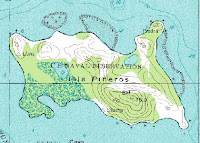
We left port under a low-low tide (due to the full moon) and arrived at Isla Piñeros, four hours later, under a high-high tide. In the Caribbean, tides ebb and flood about a foot (down a foot, up a foot, …). Under a full moon, there is nearly a three-foot difference. As we left port at Sunbay Marina, we saw coral reefs’ sharp top edges in rows as shark teeth, where normally they are never seen. We know they are there by studying charts, GPS images and snorkeling visuals. They were visible in strength today because of the full moon.

The wind was blowing from the south and according to NOAA, it would change to SW during the night. South winds do not happen often in the constant easterly Tradewinds region. The normal easterly winds make for uncomfortable sailboat movements during visits and overnight stays at Isla Piñeros. Its coastline is surrounded by irregular shallow coral reefs, another reason why it is not often visited. Prevailing S and SW winds made it just right to overnight by the island.

We approached it as Pinzón could have approached it on a visit to Puerto Rico (Martín Alonso Pinzón was captain of the Pinta. His younger brother, Vicente Yañez Pinzón was captain of the Niña in Columbus’s expedition in 1492.). Kevin was lookout at the bow, kneeling over looking out for uncharted reefs and a sandy spot to anchor. Julie checked the charts and I was following with the GPS, noting the approach. For those interested, you aim at the center of the northeast bay where there is a rocky promontory, at a 205º heading to avoid reefs (exit straight out at a 025º heading).

After we anchored for the night, the winds and waves freshened. Our anchor faced us into the wind, but the current hit the sailboat abeam (on the side), creating a not so comfortable rocking motion. I learned to do a bridle on the anchor. You tie a rolling hitch with the end of a long line to the anchor line at the bow. The standing part of that rolling hitch line is cleated midship to a horn cleat. You give more scope to your main anchor until the bridle moves the bow to the current. The calming effect is immediate. After a BBQ dinner hosted by Kevin and Julie, we slept in the comfort of a gentle sea sway.

On Friday morning, the Captain snorkeled the coast to check the reef area. Kevin and Julie checked the anchors. I stayed onboard and took care of the galley mess from the night before, plus jotted some notes for this blog. Even though the visibility was not great due to the weather, two manta rays and blue tropical fish schools were sighted.

We returned with freshening winds, so we reefed the main and changed the genoa to a jib; a smaller sail area. There was some rain on the way back and we wore our rain jackets. It was good to practice sailing under the rain with freshening seas under the expertise of Capt. Michael. The skies never cleared and we never saw the moon, but we felt her presence and inspiring tug.

--Full Moon Unseen--
Feeling moon’s tug on me
Raining wind’s harmony
Sweet music on shrouds’ strings
Shrouds resounding white wings
Cloudy night sky’s high C
Sailing Caribbean Sea

Monday, May 3, 2010

On Tropical Tides


Monday, March 22, 2010 was a local holiday for some—The Abolition of Slavery in Puerto Rico. Not being a U.S. federal holiday, most people worked. In sailing terms that meant that the usual Saturday and Sunday crowds were gone. We sailed out at about 10:00 a.m. When we arrived at Palomino, we had over 10 moorings to choose from. What a treat! I could not help but feel sorry for the other wage slaves. On such a beautiful sailing day, I was reminded of Jacques Prevert’s line in one of his poems, “N’est-t-il pas con de donner un tel jour a un patron?” (Isn’t it a #@%& to donate such a day to a boss?).
I was captain of Bebe II (32’ Benetau). Two invited friends from Atlanta, Georgia were with me, Jo Anne and Hugh, as well as Francisco, who is highly experienced and William, a new club student with some experience. After mooring in Palomino, Jo Anne and Hugh went for a swim (see picture above). Francisco did some scraping on the sailboat’s bottom. William and I stayed on board tidying up, reviewing sailing notes and relaxing.


The Sea Around Us     As we sailed back at around 4:00 p.m., the wind was behind us. The tide was with us also, so with only the jib on, we arrived back quickly. I find tides to be fascinating movements. Rachel Carson’s chapter on "Tides" in her book, The Sea Around Us (1951), provides an eloquent description of tides and their connections with the moon, currents, flora and fauna in the sea, and yes, sailboat movements. In 1962, she published, Silent Spring, where way ahead of her time, she denounced the future impact of industrial waste. Industry and government, with the help of prominent male scientists accused her as a crackpot, a modern day witch-hunt. If we had only listened. Now Rachel Carson (1907-1964) is revered as a great writer, ecologist, and scientist (see picture below). She has more books, though I highly recommend the two I mention. They are very well written, which makes for enjoyable reading, and they are still informative.


     Tides are like the planet Earth’s breathing in and out. Tides in the tropics are smaller than at higher latitudes. They usually average one foot high or low. No dramatic Bay of Fundy here. The tropical tides on the east side of Puerto Rico are easy to follow. They ebb north and flood south. If one looks at the current, without consulting a tides table, it is possible to determine the tide. We flooded right into the marina with the tide. Freedom!

Thursday, February 18, 2010

Night Sail


On Sunday, February 14, 2010, I joined Captain Michael from the Caribbean Sailing School & Club on board Bébé (41’ Beneteau). He was conducting the practical component of the ASA 104 class, where students go on a night sail. The students were two young couples—Kim and Brian from Rhode Island, and Eugenia and Gerd from New York. I had done this night sail on a full moon night previously. This night there was a new moon (no moon), and on a pitch-black canvas, we sailed into Palomino Island.

We left Sunbay Marina at about 4:30 p.m. The students were busy working on the navigation to the island, without GPS. With the aid of navigation instruments (a good chart of the area, parallel rulers, dividers, pencil, eraser, magnifying glass, calculator, timer), they calculated our route, tracks, estimated time for tacks, compass degrees, and all taking into consideration the sailboat speed, wind direction and currents, while avoiding coral reefs and sunken vessels. Their calculations were very accurate. They would take turns navigating and helming.

At about 8:30 p.m., we approached Palomino. At that point Gerd and Eugenia went forward with a boat hook and flashlights to search for a mooring and warn the helmsperson (me) of any dangers, such as approaching vessels without lights. It was so dark it was impossible to see where the water ended and the land started. As we made our approach, a dinghy without lights, not even a flashlight, passed by us. There were a few lights on the southern part of the island. There were also three anchor lights from moored sailing vessels, and a few lit motorboats. They were like dots of light on a black canvas. I felt so blind behind the helm, begging for someone to light up a mooring that I could see and aim to. Though apprehensive, I never felt fear. I had confidence in the team’s knowledge and work.

Finally, we saw a mooring to our starboard side, not far from one of the moored sailing vessels. I followed the directions of those at the bow pulpit holding the light on the mooring and with the boat hook ready to grab the mooring line. Capt. Michael shone a powerful hand-held spotlight on the mooring for the aid of those at the bow and behind the helm. It was a beautiful sight to see that white mooring ball floating in the water. After securing the mooring, Brian and Kim took charge of the BBQ, and we grilled fish, veggies, Polish sausages and hamburgers. We toasted to our accomplishment, teamwork, talked a lot of sail talk and readied ourselves for a well deserved rest and relaxation. We drifted to our cabins and berths under Orion’s watchful eye, peaceful seas and 78º F. Who could ask for anything more?

On Monday morning, February 15, 2010, Gerd and Eugenia treated us to a breakfast of scrambled eggs with veggies, mango salsa and biscuits. As they finished their cooking, Capt. Michael moved Bébé to a mooring closer to the beach. After breakfast, there was swimming, boat bottom scraping, cleaning up, and planning the day’s circumnavigation of Palomino. Small sea creatures and plants love the Caribbean as much as the larger creatures, and bottom cleaning sessions must happen much more often than up north.

Circumnavigating Palomino Island was a special treat for me. I had never seen the other side of the island. It was like visiting the other side of the moon. As we passed Palominito Island on the south, avoiding the extended shoal, we turned north, making sure to leave red nun #2 to our port side. We aimed at the house in Cayo Lobos. This white house is the only construction on the island and it is claimed to belong to Ricky Martin. We sailed past it and towards Las Cabezas de San Juan on the northeast corridor of the Puerto Rico mainland. The big island was covered in a white mist from the Montserrat volcano ashes.

The students practiced man overboard with a tack and heave maneuver. It is a simple and effective move that practically brings your sailboat to a stop next to the “victim,” in this case a roped boat fender. We returned to Sunbay Marina at about 4:30 p.m. with the ebb tide. Two of the students were reluctantly flying back to snowy New York that evening. The other two were staying for more lessons before returning to their home state. I drove back home to San Juan, midst Montserrat volcano grey-white ashy skies. Somewhere up above Orion was watching.

Monday, February 8, 2010

Sailing with Yuquiyú [joo-key-‘joo]

LOG: Sunday, February 7, 2010. Winds, S, 5-10 Knots; Seas, 3-5 ft.; North swells; Pressure 29.85 and rising.

We left the Sunbay Marina dock in Fajardo at 11:00 a.m. Ramón and I sailed Caribbean Sailing School & Club’s Bébé II (32’ Beneteau). We island hopped all afternoon, first to Icacos Island. There weren’t many people out at sea, perhaps because of the super bowl. I’d rather be sailing!

The wind was indecisive; swaying from the south, then southeast, then east, and back through the cycle again. Ready to meet the challenge, we adjusted sails at every turn. From Icacos, we headed to Cayo Lobos (Ricki Martin’s island), to Palomino Island, and then to Ramos Island.

During the course of the day, dark gray thunderheads over El Yunque rainforest changed to cumulus clouds, normally associated with fair weather. As we headed to Ramos, I took the picture of El Yunque seen here. At this distance from shore, it barely reflects its 3,500 foot elevation. One can only imagine the bromeliads, impatiens, wild orchids and giant ferns in this spectacular national rainforest. On a mystical level, the Taino people designated it the throne of the good spirit, Yuquiyú, who protects the Island of Puerto Rico from the malevolent spirit, Huracán. Declared or not, to me it was, is, and always will be one of the world’s natural wonders. Imposing, breathtaking, grandiose and commanding, even from a distance.

We returned at 4:30 p.m. to the usual chores of coiling lines, adjusting dock lines, hosing the sailboat, scrubbing soiled spots, connecting to shore power, covering hatches and sails, leaving the sailboat in as good or better condition than we found it. Tired to the core, but re-energized for the week ahead, we had lived the dream of sailing the Caribbean blue sea alongside Yuquiyú’s green rainforest.

Tuesday, February 2, 2010

The Power of Suggestion


Sunday, January 24, 2010. The sky was mostly clear with a few scattered clouds. The wind was hardly blowing. My sailing day had a rough start. At the marina, I had left my car keys in the car, along with all my sailing gear, cell phone and money. I had to borrow a cell phone to phone home for help. My son and husband came to the rescue and an hour later opened the car; we exchanged goodbyes and thanks and good days. My sailing friends—Ramón, Silvia, Carlos—waited for me onboard Lolita.
I received a text message from Glory Days’ captain, already at sea, saying there were hurricane winds blowing. NOAA’s weathercast was good, but they had predicted a small craft advisory for Monday, the following day. I remember wondering if the weather had arrived early out at sea, though not yet at the dock area. As I boarded Lolita, I shared the content of the message. We reefed the main and put up the jib instead of the genoa. As we motored out around noon, we hoisted the main and set the jib. The sailboat practically floated in place, alongside a small group of Brown Boobies (Bobas, in Spanish).
It then hit me that the other sailboat’s captain was being sarcastic, and that in jest he meant the opposite; there was no wind. Aside from a proper name for a bird, the word boba in Spanish has another connotation—silly or fool. I felt as one alongside my feather friends. I was a victim of the crew’s teasing for the rest of the afternoon. In the calmness of the Caribbean Sea, they would hold on to the rail and the mast to avoid being blown by the “hurricane” winds.
A Guide to the Birds of Puerto Rico and the Virgin Islands: Revised EditionThe Brown Booby, according to H. Raffaele’s Guide to the birds of Puerto Rico and the Virgin Islands (1989), is “seen virtually everywhere in the Virgin Islands, but in Puerto Rico the best places to look for the bird are at Cabo Rojo Lighthouse and Las Croabas. … Their leisurely flapping and gliding flight, low over the water, is characteristic, as are their spectacular dives into the sea in pursuit of fish and squid.” This Sunday, they were floating, with some light fishing.
As we sailed on, rather putt-putted along, Ramón and Silvia changed the jib to a genoa. The bigger sail gave us an additional one and a half knot. Carlos helped with the main. I was behind the helm, taking it all, and joining in the occasional laughter. Glory Days sailed by us midway and took a picture of us in Lolita with the Fajardo Lighthouse in the background. Idyllic.
It was still a good sailing day, and as we returned around 4:30 p.m., the wind freshened some, but not much. There was a lesson in there somewhere. However, at the end of the day, if one must err at sea, as one will eventually, it is best to err on the side of safety.

Friday, December 25, 2009

Merry Christmas & a Happy New Year!


May you have fair winds and following seas in the new year!

Monday, December 21, 2009

Once Upon a Blue Moon, on a Winter Solstice Eve


Once in a blue moon, there comes a day when you may have the clearest skies, in-the-groove sails, perfect tide, proper wind, following seas, and you feel a part of the best sailing team ever. Yesterday was such a day.

I woke up at 5:00 a.m., and as I readied for yet another Sunday sail, I checked the marine weather on my iPhone. There was a small craft advisory in effect until 6:00 a.m. I wondered what the implications would be for the day. What is it like immediately after the advisory ends?

The wind was S-SE, as opposed to our faithful easterly Trades. The sky was clearer than ever. I mimicked Barbara Streisand, humming the song, “On a clear day, rise and look around you, and you’ll know who you are …”

Bob, Silvia, Marisol and I sailed Bebe II (32’ Beneteau) to Icacos Island from Sunbay Marina in Fajardo, departing at 11:00 a.m., and returning at about 6:00 p.m. There were scattered clouds, dwindling white caps and big breakers on the distant northeast corridor turn by Las Cucarachas. Subsiding waves and wind, the sailboat shimmered across a high-tide peaked current. Mainsail raised and jib unfurled, we couldn’t stop repeating, “What a great day for a sail!” A present to one another—a Christmas sail to remember.

We wandered to Palomino Island, played tag with Glory Days, and at about 1:30 p.m. anchored behind her in Icacos. We were boarded by Carlos, Glory Days’ captain. The boat talk was intertwined by comments on this sailing day perfection. A day so clear, we could see St. Thomas, a good 23 miles visibility, a first time for us, so close to Fajardo. They were all present: Vieques, Culebra, St. Thomas, and the myriad islands and cays in between. The lighthouses in Fajardo and Las Cucarachas shone under the sun.

After anchoring, we plunged into the water, some in some out, pensive, smiling, cleansing body and spirit with sea salted waters. As I floated, holding on to the sailboat by a length of rope on a floating fender, I closed my eyes. I heard the Caribbean Sea singing to me through John Denver’s song, Tradewinds: “I can make you happy! / If I can, I take you away on a wave in my arms / never leave you on the edge all alone. / If you feel like dancing, / rolling like the water across my sleepless night / making me a peaceful place. / All my life to be with you / all I ever want to do / knowing you are feeling that way too / …” Oh, I feel that way too; at one with the sea, sun, sky, sailboat, sailing friends, islands, cays, and my thoughts like shimmering clouds.

A blue moon happens when there are two full moons in the same month. It doesn’t occur often. This month, December 2009, there was a full moon on December 2nd and the next blue moon will be on December 31st. We will now have to wait three more years for the next blue moon, on August 2012 (August 2nd and August 31st). Anyone for a Caribbean blue moon sail?

A day imbued with magic—a Christmas sail—we said our farewells. All heading home for Christmas, to Houston, Trujillo Alto, San Juan—filled with best wishes and memories of that island Christmas sail. And as I drove back home that night, there was a waxing crescent moon smiling at me, midst two December moons, once upon a blue moon, on a winter solstice eve.

Monday, November 16, 2009

Doing Something Good for the Earth - Around the Americas


On November 3, 2009 at 11:00 a.m., a representative group of three students from my English courses visited the sailing vessel, Ocean Watch, docked at Pier #1, Old San Juan. The Ocean Watch is presently circumnavigating the Americas. It departed north from Seattle, Washington, across the Arctic due east, down south past New York with a brief 4-day stop in Puerto Rico before heading to Brazil. You can follow the expedition around the Americas, clicking their site under my favorite links.

Dr. Michael Reynolds, Oceanographer in this scientific sailing exploration and adventure invited us to visit and tour the sailboat and kindly made the time to talk to students. Those who were unable to go wrote questions to the crew, which I emailed to Dr. Reynolds. Today I received his answers to the students. Following is a copy of the email.

To: Eva de Lourdes Edwards, delourdes@mac.com

From: R. Michael Reynolds, RMR Co., LLC

cc: none

Date: 2009-11-13, 02:20:33

Subj: Questions from students

Hi,

It has taken me some time after leaving San Juan to get organized so this reply will be a little late. I am going to put these and some other questions into one of my regular reports.

Questions:

Q: In addition to watching the ocean, what other things do you do during the voyage that you may not put in the website? (Jenni)

Ans:

This is a small boat (I have to remember to call this a boat, not a ship) and our crew is only six people. Therefore there are chores we all must share. I cook dinner or clean the dishes sometimes. I help keep the boat clean. I stand watch like everyone else. Do you know what "watches" are? We are divided into two groups. Each watch group will be on duty to operate the boat while the others are free to sleep, eat, or just relax. Here are the hours of the day for watch: day: 06-10, 10-14, 14-18, and night: 18-21, 21-00, 00-03, 03-06. Each group takes turns. As I write you this now it is 2:50 in the morning and my watch is almost over, but I only have three hours to sleep then I have to be back up at 6 am.

Q: What do you think about the contamination problems in the ocean around the Americas? (Yineza and Kenny)

Ans:

I am very concerned about how humans have treated the oceans as a dumping place for garbage, pollution, and human waste. However, it is easy to see when you are out here in the open ocean how we might think the ocean is infinite. It seems so vast. But of course it isn't.

Q: In what moment did you decide to go around the Americas and why? (Janice, José Manuel and Kiara)

Ans:

I work with the University of Washington and one of my colleagues suggested I come to a meeting with some people who had this crazy plan to sail around North & South America in a sailboat. I went to the meeting and met the crew and I realized this was a chance of a lifetime for me. I have traveled a great deal as an oceanographer and I have sailed small boats for fun. But I have always wanted to do blue water sailing offshore. This was my opportunity to sail and do something good for the Earth.

Q: What do you recommend to protect our ocean? (Janice, José Manuel and Kiara)

Ans:

First educate yourself. Take courses, read magazines, and learn all you can. Don't just learn how there are problems; learn all about the wonders of the sea. Second, start doing the little things to change your habits. Never, never throw plastic in the sea and don't be afraid to tell others the same. Drive less; think about how you can conserve energy. All the little things. And third, become political. Join an environmental group, write letters to politicians, and stay informed on local issues. Remember the old advice to think globally and act locally.

Here are two questions that can have the same answer.

Q: What have you seen that you consider amazing? (Frances)

Q: What is the most impressive thing that you have seen in this voyage?

Ans:

We have seen so many amazing things so far: whales, polar bears, huge ice bergs, storm waves fifty feet high and glorious skies full of stars. But the thing I am enjoying the most is occurring right now in the equatorial ocean: the clouds. This is the place where weather happens. Huge towering cumulonimbus clouds rise to the top of the atmosphere then spread across the sky as anvils. These are a joy to watch. Oh yes, the stars at night are limitless.

Q: What inspired you to make this cruise? (Yolady, Irishka, Zuleyka)

Ans:

I have lived a good life. I have a terrific family and my job has taken me all over the world. As an oceanographer I have been concerned with the environment my whole career. But I have not had the opportunity to "give back." At least to my satisfaction. Around the Americas fills my wish. I can meet people and show first hand how important it is to protect our natural world. And it's fun too!

Q: What do you need to travel around the Americas? (Evalyannit and Indira)

Ans:

I am not sure how to answer this question. First you need people with vision; people who have the idea that with this trip we can capture people's imagination and interest. Next after the idea you need money. This is not a cheap trip and so you need supporters who will donate money, time, and gifts to support the project. You need a crew of dedicated sailors. People, and their families, who will take about two years out of their life for this project. And then, you need people like you who take an interest in what we are doing, and, very important, in what we have to say.

Q: What is interesting and entertaining about our oceans? (Cindy and Xiomara)

Ans:

The ocean is a wonderland and the more you look into it the more you can learn about ourselves. Did you know a dolphin can hear your heartbeat in the water? That the eyes of an octopus are much more advanced than our human eyes? That the Albatross travels twenty thousand miles to bring some food home to the family? Read all about it and you will be amazed. Read, read, read.

Q: How does it feel to discover different cultures? Do you like to learn from them? (Pamela)

Ans:

One of the most exciting parts of this expedition is that we are meeting and talking with people of all cultures along the way. We have met Native Americans on Vancouver Island, Inuit (Eskimo) people in Alaska and Canada, and now we are entering the Latin communities from Puerto Rico, South America, Central America and Mexico. We are all thrilled and excited to meet these people and to learn from them their lives. Everywhere we go we hear a consistent story of concern for the changing ocean and the changing climate.

Q: What made you decide to work for the environment? (Ninotchka)

Ans:

You never know where your life might take you. I was born in Dallas Texas and never had too much to do with the ocean until I began graduate school. Actually, I decided to become an oceanographer because I wanted to study Earth science (Geology, Geophysics, or Physical Oceanography) and at that time Oceanography was new. As I studied Oceanography I became aware of the environmental issues and so it was natural to try to share that knowledge with others.

Q: What does your family think about what you are doing? (Lizette)

Ans:

They miss me of course. I always walked our dog Lucy and now they have to do it rain or shine. So I think they will be happy to see me come back.

Q: What has caused you the most fear? (Marisely)

Ans:

The first time I was hoisted to the top of the mast in a canvas chair I was a little nervous. I go up there to tend to the climate instruments. Now I am used to it. Also I miss my family and I fear something bad might happen and I am days away at sea. But I worry far too much.

Q: How can this expedition help nature instead of just being aware of its problems? (Juan Carlos)

Ans:

Our main supporting organization is called "Sailors for the Sea." Their goal is to convince sailors to become protectors of the sea. These sailors will carry the idea from their own personal choices to friends, employees, and politicians. That is one way the message can go from idea to practice. But the truth is that being aware is the first step in actually doing something. We want to stimulate people to begin to learn the issues.

Thank you, Dr. Reynolds, and all the Ocean Watch crew.


Saturday, November 7, 2009

Sailing with new sailing students


Sun 18 Oct 09. 1130-1530. On board Bébé (41' Beneteau) with Captain Michael, five new sailing students, plus Ramón and myself. Weather--Wind: SE 14-18 knots (According to NOAA, small craft should exercise caution). Seas: 3-4 ft. Clear skies. Barometer: 29.75 in. Hg. (rising).

It is always good to sail with students. One always learns something new. Capt. Michael asked Ramón and I to serve as mentors to the new sailors. I learned to take a sailing boat out going backwards. We practiced tacking, knot tying, and docking. We met new friends and future sailing companions.

Sunday, September 13, 2009

Dockmanship

LOG: Sat 12 Sep 09. 1000-1400. Onboard Lolita (30’ Beneteau, 1984). Crew: Silvia, Inés, Hernán and myself. Weather—Wind: E 10-14 knots (We experienced the 10 knots mostly.). Seas: 2-4 feet. Sky: Cumulus white clouds on the horizon to the east and southeast. Barometer: 29.92 in. Hg. (steady). Position: Between Sunbay Marina, Fajardo and the islands of Icacos and Palomino.

Dockmanship (Cornell Boaters Library)     There is an excellent little book, Dockmanship by David Owen Bell, printed by Cornell Maritime Press (1992), which is all about docking and undocking a sailboat—berthing, unberthing; arrival, departure; alpha, omega; the beginning and the end of a sailing adventure. Bell states that, “Many people consider good dockmanship to be the mark of a competent skipper.” For many a sail lately, while I have been the designated captain, I have managed to do this task with greater and lesser degrees of apprehension (I’ve a good record so far of not damaging body or property.). The more I do it, the more I realize, it is not about an individual’s competence to manage the task, but rather an individual’s ability to conduct the task, much as an orchestra conductor leads musicians, instruments, environmental acoustics and surrounding audience. Bell says there are three components to any docking situation: (1) elements under your control: the engine, rudder and dock lines; (2) external forces beyond your control: wind and current; and (3) the human factor, partially under your control: attitude, reflexes and perception—yours and those of the crew. Docking to me is orchestrating all these factors at once in a very quick, brief, flashing sacred moment in the craft of sailing. It is sacred, if seen as entering and leaving the cathedral of the sea. Conversations cease, silence rules over occasional warnings, and everyone is focused on the musical overture.
     Such were my feelings and spirits as we left Sunbay Marina for yet another sail onboard my good old friend, Lolita. There wasn’t much wind, but the sun was shining, and after so many rainy days, threats of storms (Erika) and tropical depressions, it was a well-received welcome sail. We sailed towards Icacos and Palomino, never reaching either. As the sailors’ adage goes, once sails are up and you’re sailing, you’ve reached your destination.
     We had the company of a new Caribbean Sailing School student, Hernán (see picture), who took to sailing as a natural. After only five lessons, he joined our team where he practiced checking oil, starting/stopping the engine, raising sails, helming with a tiller, doing a heave-to, working knots and ropework, and of course joining in the dockmanship, where he was in charge of the aft starboard line and on arrival the forward starboard line, as well as assisting crew as required in our musical overture’s grand finale.

Monday, August 10, 2009

The Squall

LOG: Sun 9 Aug 09. 1200-1830. Onboard Bébé II (32’ Beneteau). Crew: Ramón, Silvia and myself. Wind: E-NE 13-18 Knots. Seas: 5-6 feet. Barometer: 29.90 steady. Weather: Scattered clouds, distant thunderheads southeast, NOAA small craft caution. Position: Between Sunbay Marina, Fajardo and the Island of Icacos in Puerto Rico.
Riddle of the Ice: A Scientific Adventure into the ArcticI am inspired to enter a log in my entries in the manner that Myron Arms writes his in the book, Riddle of the ice: A scientific adventure into the Arctic (1998). He starts every chapter with a log entry for the sailboat Brendan Isle, as it sails into the icy waters of the Labrador Sea, Davis Strait and Baffin Bay. As it ventures north, he states, “… you are a sailor, moving along with the forces of nature rather than against them. You are a minion of the wind—only partially in control of where you go …”
And so it was on this particular Sunday. We debated whether to go to Palomino or Icacos. There was a large thunderhead behind Palomino. Normally these weather formations travel east toward Naguabo. We moved northeast towards Icacos hoping to avoid it but it decided to travel northward and split north and east (to mainland Puerto Rico). Greek mythological sailors, such as Jason and the Argonauts, would have been convinced that the gods had a hand in it. It came straight to us. We came about and headed back to sea rather than to boat-crowded Icacos. In its imminent approach, we reefed the mainsail. Ramón and Silvia furled the jib just as it began to engulf us into its misty grey. I was behind the helm and felt myself becoming “a minion of the wind” and the blinding cold rain. The water looked like the pocked surface of the moon with multiple little peaks. I started the engine and headed close to the wind, working “with the forces of nature rather than against them,” well aware that our bearing kept us from harms way, if it pleased the gods.
Within five minutes that felt like five hours it passed by and the clouds opened as theater curtains to verdant Palomino in the distant center stage. We were drenched. Tissue papers deep in my pockets were soaked. Silvia said the water was colder than normal rainwater. Ramón added that it was thick and hit the skin like pellets. Me, I was so proud of being part of a team that never once panicked, at least not visibly. We pulled together to keep ourselves safe, our sailboat as steady as possible in the turmoil, and her sails intact. After a well-deserved rest in a heave-to, with Palomino to one side and the Fajardo lighthouse to the other, we sailed back uneventfully to Sunbay under sun-clear skies. Scattered dark clouds headed to Naguabo, some to the distant north Atlantic, perhaps to the Labrador Sea.